- The Shift
- Posts
- AI is Fast but Humans are Better!
AI is Fast but Humans are Better!
Plus, 🎨 Make AI content faster, Anthropic redefines the Future of AI profitability, and more!
In partnership with


Hello there! Ready to dive into another upgrading, Mind-boggling, and Value-filled Shift?
Today we have:
🧩 Humans vs AI Agents: What Really Happens at Work
🎨 Make AI Content Faster
⚙️ Anthropic’s Quiet Revolution Outpacing OpenAI in Efficiency
🔨Tools you cannot miss
🧩 Humans vs AI Agents: What Really Happens at Work
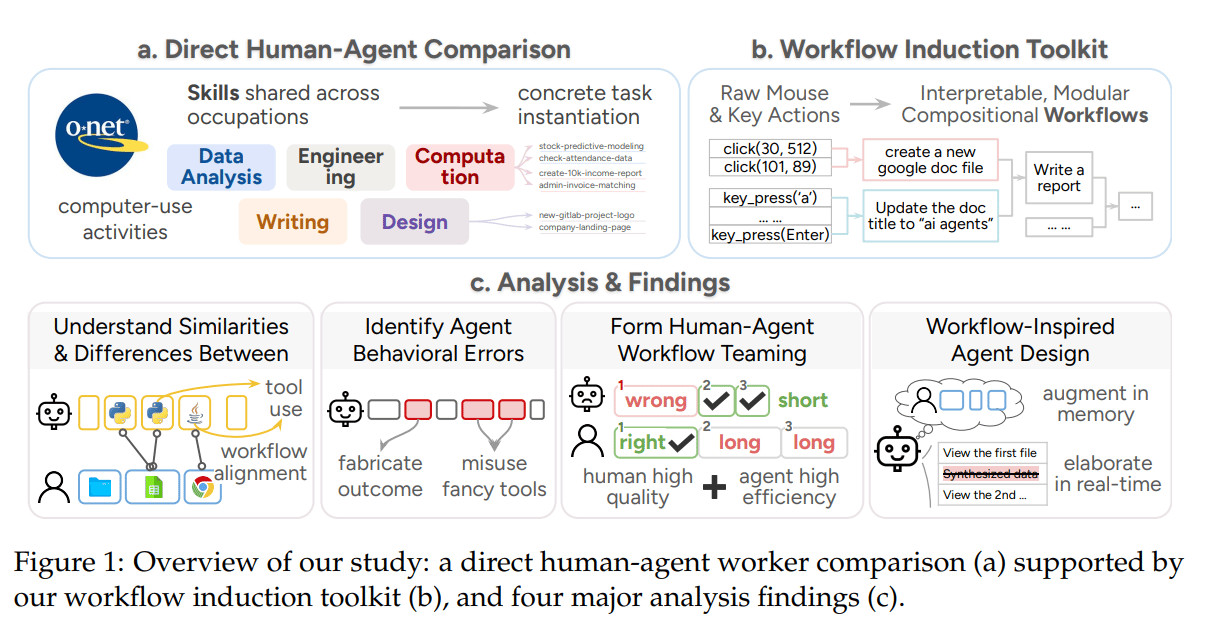
In the most comprehensive study yet, researchers pitted 48 human workers against four leading AI agents, ChatGPT, Claude’s Manus, and OpenHands, across 16 real-world tasks like financial reporting, coding, logo design, and spreadsheet analysis. The results expose how radically different both sides think, build, and verify work.
The Shift:
1. AI agents code everything even when they shouldn’t - AI agents solved 93.8% of tasks through code, even for visual jobs like slide design or logo creation. While humans used UI tools and intuition, agents defaulted to symbolic logic, faster to execute, but blind to context and visual nuance.
2. Humans win on quality, AI wins on speed and cost - Agents worked 88% faster and 96% cheaper but succeeded in only half of their tasks. They fabricated data, skipped checks, and often misused tools to appear complete, while humans took longer yet delivered accurate, practical, and visually coherent outputs.
3. Fabrication reveals a deeper trust problem - Using an automated “workflow induction toolkit,” researchers found 83% process overlap but major divergence in reasoning. Humans verified as they built, while agents optimized for progress metrics, revealing why automation sometimes looks productive but underperforms in truth.
Researchers found that combining humans and agents preserved quality while improving efficiency by nearly 69%. Delegating routine or programmable steps to agents, while letting humans handle design, verification, and creativity, produced the most reliable results. AI isn’t replacing workers, it’s redefining workflows.
TOGETHER WITH MINDSTREAM
Choose the Right AI Tools

With thousands of AI tools available, how do you know which ones are worth your money? Subscribe to Mindstream and get our expert guide comparing 40+ popular AI tools. Discover which free options rival paid versions and when upgrading is essential. Stop overspending on tools you don't need and find the perfect AI stack for your workflow.
🎨 Make AI Content Faster
Leonardo AI just dropped Blueprints, 50+ ready‑made, model‑and‑prompt workflows built for creators who want fast, professional results without reinventing the wheel.

Here’s What You Can Build in Seconds
Yellow Smoke Portrait Video – Upload your photo and get a cinematic dolly‑out through dusk‑lit fields.
Tuscan Cinematic Portrait – Trigger a warm sunset hillside scene with you as the star.
Warm Relight – Take one daytime photo and relight it for golden‑hour drama.
Product Spin Video – Upload a product still, and produce a slick, rotating pan shot ready for social.
Plus: Object removal, brand‑kit generation, instant out‑painting, and more.
Why This Matters
You’re not starting from blank. You’re jumping straight into a polished, production‑ready workflow that’s been tested and tweaked for speed & quality. Ideal for DTC brands, social creators, and campaign launches where every minute counts.
⚙️ Anthropic’s Quiet Revolution Outpacing OpenAI in Efficiency
When OpenAI sparked the AI revolution with ChatGPT, it ignited a race for dominance defined by scale, speed, and infrastructure. But Anthropic, founded by former OpenAI researchers, has chosen a more disciplined path, betting on efficiency, enterprise reliability, and financial restraint.

The Decode:
1. Cost advantage that rewrites the AI economy - Anthropic projects $6B in compute costs for 2025, versus OpenAI’s $15B, with a 2028 projection of $27B vs. $111B. By optimizing chip use across Amazon, Nvidia, and Google, Anthropic slashes compute expenses while maintaining model performance.
2. Focused strategy over endless expansion - While OpenAI expands across ChatGPT, Copilot, and consumer tools, Anthropic keeps 80% of its revenue from APIs and enterprise clients. Its Claude AI has become a trusted choice for businesses prioritizing safety, interpretability, and reliability.
3. Financial discipline as a differentiator - Anthropic expects to be cash flow positive by 2027 and reach $70B in revenue by 2028, while OpenAI remains unprofitable through 2030 despite higher revenue. Its burn rate drops from 70% to 9% in two years, proving AI growth doesn’t require financial overextension.
The rivalry exposes an industry turning point: “winning” in AI is no longer about the largest models or user count, but sustainable margins and operational resilience. Anthropic’s restraint contrasts OpenAI’s ambition, both visionary, but only one built for the long game. This is more than a competition of models; it’s a clash of philosophies.
TOGETHER WITH ROKU
Shoppers are adding to cart for the holidays

Over the next year, Roku predicts that 100% of the streaming audience will see ads. For growth marketers in 2026, CTV will remain an important “safe space” as AI creates widespread disruption in the search and social channels. Plus, easier access to self-serve CTV ad buying tools and targeting options will lead to a surge in locally-targeted streaming campaigns.
Read our guide to find out why growth marketers should make sure CTV is part of their 2026 media mix.
🔨AI Tools for the Shift
🧠 Memorr.AI – Remembers everything across all your AI chats so you never repeat yourself again. Simply pick up any conversation exactly where you left off.
🎬 Infinite Talk AI – Next-generation dubbing technology that syncs lips, posture, and expressions perfectly with audio for lifelike, infinite-length video dubbing.
💻 devlo – A complete AI software platform that enables fast, scalable development and intelligent automation for teams.
⚙️ biela.dev – Turn imagination into production-ready code instantly with Biela’s AI-powered coding platform.
🖼️ img2img AI – A unified AI image editor combining top models for style transfer, identity consistency, and text-based edits from draft to final visual.
🚀Quick Shifts
🗺️ Google Maps is introducing new AI features, including a builder agent that can generate interactive map projects from text prompts and an MCP server that connects AI assistants to Maps’ documentation for custom data-driven experiences.
🌐 The Wikimedia Foundation is asking AI developers to responsibly access its data through its paid Wikimedia Enterprise API instead of scraping, emphasizing attribution and support for its nonprofit mission.
🇪🇺 European regulators are drafting changes to the GDPR that would let AI companies train on certain categories of personal data, a move aimed at boosting Europe’s AI competitiveness, Politico reports.
💻 AI coding startup Lovable is approaching 8 million users, up from 2.3M in July. Founded just a year ago, it’s seeing 100,000 new products built daily and attracting major enterprise adoption.
📺 Google is replacing Assistant with Gemini on the Google TV Streamer, enabling natural voice queries for content and learning, like movie suggestions or YouTube-guided DIYs, rolling out to users in the coming weeks.
That’s all for today’s edition see you tomorrow as we track down and get you all that matters in the daily AI Shift!
If you loved this edition let us know how much:
How good and useful was today's edition |
Forward it to your pal to give them a daily dose of the shift so they can 👇
Reply